When evaluating a security suite that protects hundreds of millions of machines globally, you have to look past the marketing. Avast Antivirus has been a household name for over two decades. Yet, as operating systems like Windows 11 refine their native defenses (Microsoft Defender) and cybersecurity threats shift from basic Trojans to sophisticated, AI-driven phishing and silent ransomware attacks, the core question changes.
Is installing Avast in 2026 a genuine security upgrade, or are you just trading processing power for endless pop-up notifications?
This deep-dive review breaks down Avast’s underlying engine, evaluates the real-world performance of both its free and premium tiers, weighs its pros and cons, and identifies the exact use cases where it genuinely shines.
The Core Engine: Under the Hood of Avast Antivirus
Avast operates on a massive threat-intelligence network. Because of its sprawling user base, when a machine running Avast in one part of the world encounters a novel piece of malware, a signature is analyzed and pushed out globally within minutes.
Independent testing labs like AV-TEST and AV-Comparatives consistently validate this infrastructure. In their 2026 evaluations, Avast routinely scores a 6/6 in Protection or earns the “Top Product” distinction, frequently blocking 99.9% to 100% of real-world malware samples.
The software achieves this through layered, modular defense blocks:
- File Shield & Web Shield: Scans files as they are opened and blocks malicious scripts or dangerous URLs before your browser executes them.
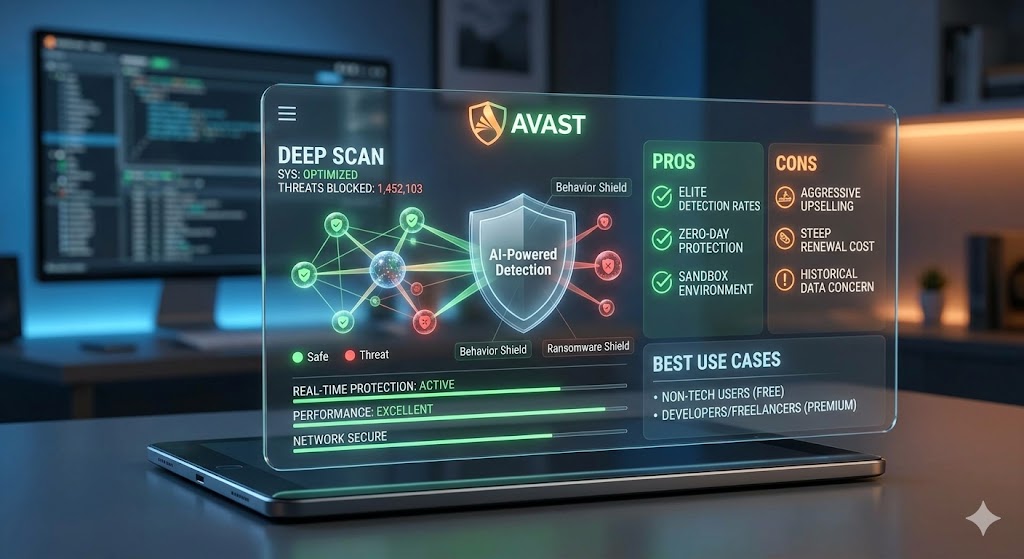
- Behavior Shield: Monitors running apps in real-time. If a trusted application suddenly starts altering core system files or attempting unauthorized encryption, the Behavior Shield flags and isolates it. This is your primary defense against zero-day exploits.
- Ransomware Shield: Creates an extra, locked-down folder perimeter around your most valuable files (Documents, Photos), preventing unauthorized applications from modifying or encrypting them.
Avast Antivirus Free vs. Avast Premium Security vs. Avast Ultimate
Avast has streamlined its lineup into three primary buckets, now tightly integrated into the modernized Avast One ecosystem layout.
| Feature / Tier | Avast Free Antivirus | Avast Premium Security | Avast Ultimate Suite |
| Malware & Scam Protection | Yes | Yes | Yes |
| Real-time Behavior Monitoring | Yes | Yes | Yes |
| Advanced Firewall | No (Uses OS Default) | Yes | Yes |
| Sandbox Environment | No | Yes | Yes |
| Webcam & Remote Access Shield | No | Yes | Yes |
| SecureLine VPN | No | No | Yes (Unlimited) |
| Cleanup & AntiTrack Premium | No | No | Yes |
| Device Support | Unlimited Devices (Individual) | 1 to 10 Devices (Tiered) | 1 to 10 Devices (Tiered) |
The Free Version of Avast Antivirus remains one of the strongest purely reactive security nets on the market. However, active internet users will quickly feel the limitations of the free tier—not because it lacks malware detection, but because it leaves out the proactive behavioral features like the Advanced Firewall and Sandbox.
Pros and Cons: An Honest Assessment
The Pros
- Top-Tier Malware Remediation: Its zero-day threat detection and phishing prevention are exceptionally reliable. It catches complex, multi-stage scripts that basic built-in OS protection occasionally overlooks.
- Minimal System Footprint: Gone are the days when running an antivirus felt like dragging an anchor behind your operating system. Background resource consumption typically hovers very low, keeping standard tasks, file transfers, and app launches responsive.
- The Sandbox Environment (Premium Feature): For advanced users or developers, the ability to run an unverified executable file inside an isolated virtual sandbox is an invaluable asset that completely protects the host machine.
- Intuitive UI/UX: The modern dashboard design is structured perfectly for scannability, organizing complex network configurations and shields into clear, understandable toggle menus.
The Cons
- Aggressive Upselling & Monetization: Even if you purchase a paid tier, the application persistently nudges you to buy companion standalone apps like Avast Cleanup Premium or Driver Updater. It can detract significantly from what should be a premium, clean software experience.
- Pricing Scalability: While introductory first-year pricing is highly competitive, renewal rates scale upward significantly. Be prepared for a sharp price hike after year one.
- Historical Baggage: For users hyper-focused on ultimate data privacy, memories of Avast Antivirus late-2019 data-collection controversy (via browser extensions) still linger. While the company completely restructured its data governance policies and removed the offending mechanisms years ago, it remains a point of consideration for privacy purists.
Best Use Cases: Who is Avast Antivirus For?
Avast is not a one-size-fits-all product, but it excels dramatically in specific environments:
1. Casual Users and Non-Tech Savvy Relatives (Free Tier)
If you are configuring a laptop for a family member who frequently clicks unverified email links, wanders onto questionable streaming sites, or falls prey to basic phishing pop-ups, Avast Antivirus Free is perfect. Its heavy-handed web blocks act as excellent guardrails, keeping them safe without requiring manual configuration.
2. Digital Creators, Freelancers, and Remote Workers (Premium Tier)
If your computer is your livelihood and you regularly download media assets, fonts, third-party plug-ins, or clients’ shared documents, Avast Premium Security is highly recommended. The added protection of the Webcam Shield, Remote Access Shield (blocking RDP exploits), and the Ransomware Shield provides peace of mind that a basic built-in firewall cannot match.
3. Developers and System Tinkerers (Premium/Ultimate Tiers)
For power users who frequently interact with legacy applications, custom scripts, or unverified tools, the native avast antivirus Sandbox functionality alone justifies the cost. Being able to safely detonate a file in isolation saves significant time over booting up a separate virtual machine.
Where To Download?
To download latest version visit download avast antivirus
The Verdict
Avast Antivirus remains an absolute powerhouse at its core task: keeping malware off your machine. Its detection rates are elite, its interface is beautifully designed, and its impact on your system hardware is negligible.
If you can tolerate the persistent internal marketing notifications and the steep renewal pricing, it offers some of the most robust, dependable defense layers available for Windows, Mac, and Android ecosystems today.
Looking for an alternate?
read detailed review about AVG AntiVirus and Norton AntiVirus Plus
About the Author